

Lenoncourt wetland: Novacarb’s commitment
Understanding the Lenoncourt wetland and how Novacarb protects it.
Novacarb at Lenoncourt: Responsible Industrial Activity
Novacarb is a subsidiary of Groupe Humens, specialising in the production of sodium carbonate and bicarbonate, used in a wide range of industrial and everyday applications.
In Meurthe-et-Moselle, on the salt concession known as "de Lenoncourt", Novacarb operates in the subsoil across four municipalities: Art-sur-Meurthe, Saulxures-lès-Nancy, Lenoncourt and Cerville. The salt extracted in the form of brine serves as the raw material for manufacturing its mineral products. This industrial activity has a long history in the region and contributes to the local economy.
Because this operation takes place within a sensitive natural environment, Novacarb has chosen to fully integrate biodiversity preservation into its practices. This approach is part of Groupe Humens' CSR strategy, which aims to balance industrial performance with a reduced environmental footprint.
What is a wetland?
A wetland is a naturally water-saturated environment, either permanently or temporarily: wet meadows, floodplains along watercourses, marshes, peat bogs, reed beds…
From a regulatory standpoint, it is defined by at least one of the following two criteria:
- the presence of hydromorphic soils, marked by excess water (pedological criterion),
- the presence, at least part of the year, of hygrophilous vegetation specific to wet environments (botanical criterion).
Although these areas often go unnoticed, they are extremely valuable:
- They reduce flooding by absorbing water.
- They naturally filter water.
- They store carbon, helping to combat climate change.
- They provide habitat for many animals and plants, some of which are rare.
Because these environments are fragile, they must be maintained and protected. This is precisely what Novacarb does at its Lenoncourt site. To that end, a wetland management plan has been put in place to ensure the sustainable stewardship of the site and the preservation of local biodiversity.
Organized and collective management of the Lenoncourt wetland
Since 2019, several studies have been carried out to better understand the wetland located on the Lenoncourt salt concession and to establish a management plan. Each year since then, a committee meets to ensure compliance with the plan's requirements, decide on the actions to be taken and verify their effectiveness. This committee brings together:
- Novacarb (Groupe Humens)
- The municipalities concerned
- Land owners
- RTE
- Neomys and its partners (biodiversity expert associations)
Their shared goal: to protect this environment threatened by human activity and climate change.

Map of the wetland within the salt concession
Actions to Preserve the Lenoncourt Wetland
Maintaining the meadows
The wet meadows are managed as follows:
- some are mown late in the season once a year, or not at all,
- others are lightly grazed to preserve plants and insects.
Preserving hedgerows and trees
Shrubby areas are retained, but the poplar trees that were planted in the past are not being replaced at the end of their lifespan, allowing natural hygrophilous vegetation to develop in their place.
Controlling invasive plant species
Certain non-native plant species introduced by humans, known as invasive alien species, threaten biodiversity and local species by competing for the resources they need to survive. Measures are being taken to remove them and restore space for native plants.
Restoring water to the landscape
To keep the area sufficiently wet:
- the wetland character of certain zones has been restored by removing the topsoil layer to reduce nutrient levels and encourage the establishment of specialist species,
- ditches have been filled in to reduce drainage and allow the land to remain waterlogged for longer during winter and spring.

Turf stripping @F.Parisot
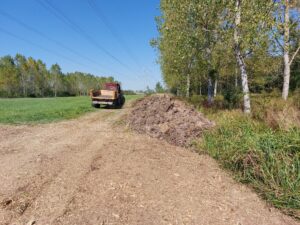
Ditch infilling @F.Parisot

Turf stripping @F.Parisot
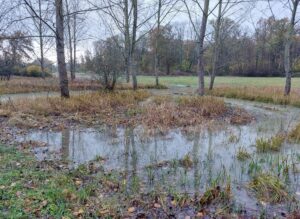
Waterlogged area after ditch infilling @F.Parisot
Rare and Protected Species
Monitoring carried out between 2020 and 2025 has recorded several remarkable species in these habitats:
- the Great Crested Newt,
- the Scarce Copper butterfly,
- Devil's-bit Scabious (a herbaceous plant).

Great Crested Newt @Atelier Vert

Scarce Copper butterfly @atelier vert

Devil's-bit Scabious @atelier vert
To protect them:
- movement within the area is limited to what is strictly necessary for the management plan,
- the long-distance hiking trail (GR 534) that runs through the area is clearly marked,
- staff are made aware of the importance of avoiding disturbances,
- a pond with a profile suited to amphibians, and the Great Crested Newt in particular, has been dug to encourage the species to settle and thrive.
Each year, specialists monitor birds, amphibians and reptiles. Every three years, they also survey plants, insects and bats. These observations allow management actions to be adjusted as needed.

Pond excavation 2023 @F.Parisot
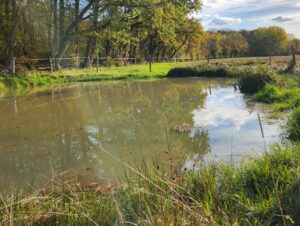
Pond October 2025 @F.Parisot
Raising Awareness and Showcasing Biodiversity at Lenoncourt
Protecting nature also means explaining why it matters. In collaboration with L'Atelier Vert, a public-interest association dedicated to environmental education, Novacarb has installed educational panels along the GR hiking trail that runs through its site. Walkers can now learn more about local industrial activity and the biodiversity challenges surrounding it.
These awareness-raising initiatives strengthen ties with the local area and demonstrate Novacarb's and Groupe Humens' commitment to biodiversity and sustainable development.
A Concrete Commitment to Biodiversity and the Environment
At Lenoncourt, Novacarb demonstrates that industrial activity and nature conservation can go hand in hand. The management of the Lenoncourt wetland is fully aligned with Groupe Humens' CSR strategy: reducing environmental impact, preserving local ecosystems and acting sustainably for the benefit of the territory.
The wetland is not simply a green space, it is a living environment, valuable to the local area and carefully maintained for future generations.